Building with Steel
Europrofil is the Nordic region’s leading specialist in sustainable steel building systems. In this guide, we’ll tell you more about the properties of steel, how we tailor steel to meet different requirements and applications, and why steel is a material of the future. Did you know that steel is already the world’s most recycled material?
What is steel?
Steel is an alloy of iron and carbon in which the carbon content is typically less than two percent. By adding various alloying elements and using different manufacturing processes, steel can be given a wide range of properties. It can range from highly malleable to extremely high-strength. In the construction industry, galvanized steel is often used; in this process, the steel is coated with a protective layer of zinc to resist corrosion and ensure the structure has a long service life. The combination of high strength, low weight, and good formability has made steel one of the world’s most versatile structural materials.
Where is steel used in the construction industry?
Steel is one of the world's most common building materials and is used in everything from residential and office buildings to schools, hospitals, industrial facilities, and public buildings. Thanks to its high strength, low weight, and great flexibility, steel is used in both load-bearing structures and non-load-bearing building systems.
In modern construction, steel profiles—such as steel studs, steel furring strips, channels, and light-gauge beams—are used for interior walls, exterior walls, suspended ceilings, facades, and various types of reinforcement structures, among other things. By selecting different steel grades, thicknesses, and surface treatments, building systems can be adapted for everything from dry indoor environments to particularly exposed environments with high demands for corrosion protection, sound insulation, or load-bearing capacity.
At the same time, steel is often an effective choice from both a production and a sustainability standpoint. The material’s high precision, low weight, and suitability for prefabrication contribute to faster assembly, less material waste, and more efficient construction.
Not all steel grades are intended for the same applications. At Europrofil, we use steel to develop profiles and complete building systems for interior walls, exterior walls, suspended ceilings, facades, fire-resistant cladding, and burglary protection —solutions that meet the construction industry’s requirements for quality, sustainability, and longevity.
9 Benefits of Steel as a Building Material
Steel as a building material offers a wide range of technical, environmental, and economic advantages. This is due in part to steel’s inherent properties and in part to the possibilities the material offers in terms of how it can be adapted and developed.
- Mold- and moisture-resistant: Steel is not affected by moisture and does not provide a breeding ground for mold or rot. It also requires no drying time, which allows you to close off structures quickly.
- Non-combustible: Unlike wood, steel is a non-combustible material that does not contribute to the spread of fire or produce smoke. At high temperatures, however, steel’s load-bearing capacity decreases, which we take into account when designing fire-rated structures.
- Healthy indoor environment: The material requires no pest control measures, emits no pollutants, chemicals, or radon, and does not bind allergens.
- Dimensionally stable: Steel does not swell, shrink, crack, or warp over time.
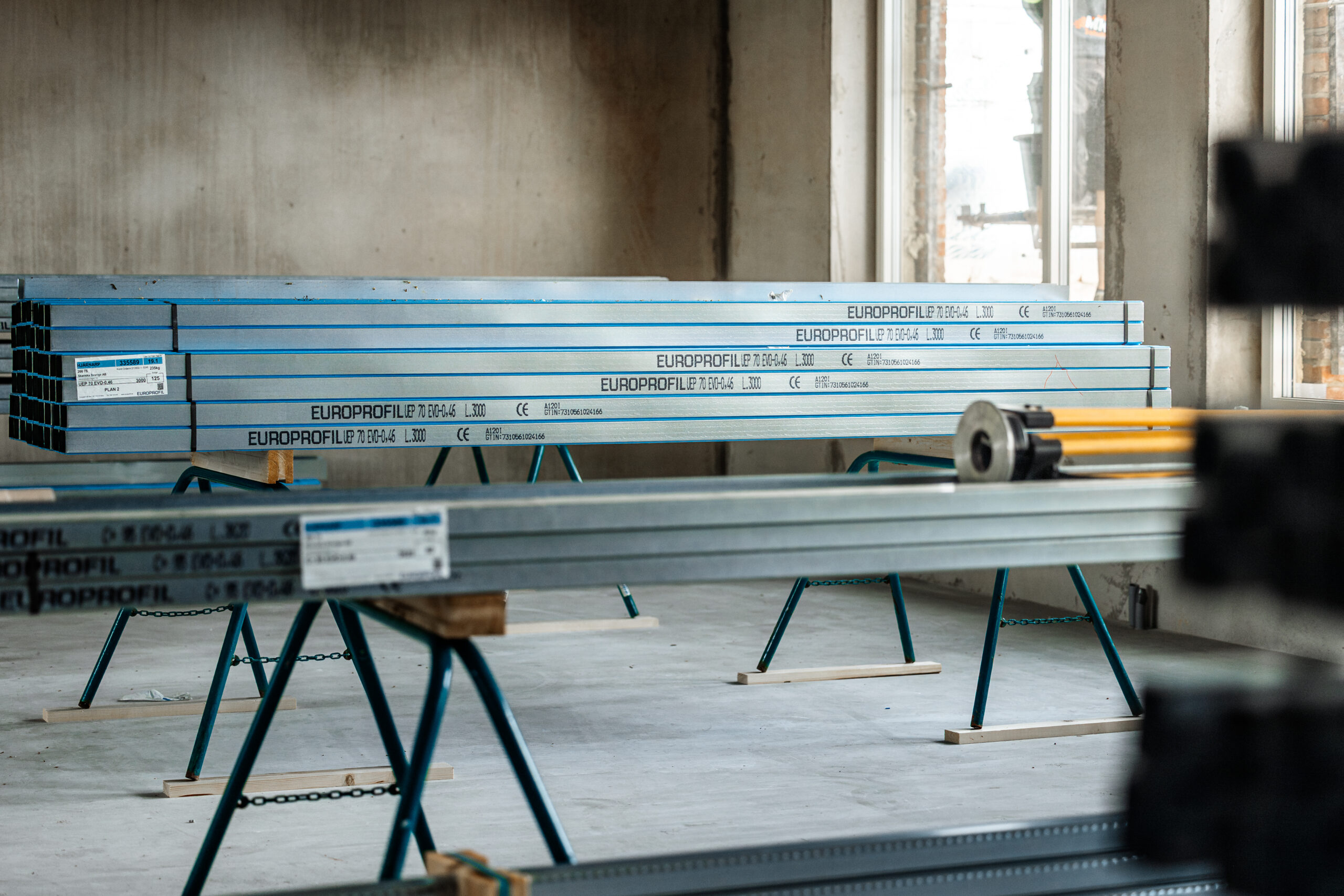
- Strong and Light: Steel’s high strength makes it possible to create strong structures using relatively little material. This results in lighter building systems and more efficient transportation and assembly. Steel sections are often delivered “boxed,” which means they take up about half the volume during transportation and storage compared to, for example, wooden studs.
- Excellent acoustic properties: Thanks to the geometry of the steel profiles and the ability to build multi-layer structures with air gaps and insulation, it is possible to achieve very good sound insulation. There are also profiles that have been specifically designed to reduce sound transmission.
- Long service life: Thanks to the properties of steel and effective corrosion protection, galvanized steel profiles retain their function and shape for a very long time.
- 100% recyclable: Steel can be recycled over and over again without losing its properties or compromising its quality.
- Reusable: You can install steel profiles, remove them, and reinstall them. There are many possibilities for reuse.
Different grades of steel
Depending on whether you plan to use the profile in a lightweight interior wall or a load-bearing exterior wall structure, Europrofil adjusts the steel’s strength, thickness, and properties. This allows each building system to be optimized based on the project’s requirements.
We offer the following material grades:
- S250GD: Structural steel with a lower yield strength (at least 250N/mm²) that we use in standard profiles, rails, and indoor suspended ceiling systems (non-load-bearing structures).
- S250 D: Structural steel with the same minimum yield strength as S250GD (at least 250N/mm²). Combined with Magnelis® for very high corrosion protection in demanding environments.
- S350GD: The high-strength structural steel (at least 350N/mm²) that we use for load-bearing elements, exterior wall studs, and light-gauge beams where the requirements for mechanical load-bearing capacity are higher.
- Evolution (EVO): Our eco-steel is designed to reduce climate impact without compromising strength or performance. It has the same technical properties as conventional steel, but with a CO₂ footprint that is more than 70% lower, and consists of at least 75% recycled raw materials.
What is galvanized steel?
Galvanized steel is steel that has been coated with a protective layer of zinc to resist corrosion and extend the material's service life. In the construction industry, galvanizing is one of the most common methods for protecting steel profiles—such as steel furring strips, steel studs, rails, and other building components—against moisture and rust.
The zinc coating acts as a barrier between the steel and the surrounding environment. If the surface were to be damaged, the zinc also provides what is known as a sacrificial anode effect. It protects the steel even from minor scratches and offers some protection to cut edges as well. The result is a material with a long service life and minimal maintenance.
The type of galvanization that is appropriate depends on where the product will be used. Dry indoor environments have different requirements than ventilated facades or exposed outdoor environments. That is why Europrofil offers several different types of corrosion protection and zinc coatings, tailored to the construction project’s requirements for durability, corrosion resistance, and service life.
Various Types of Surface Treatments and Corrosion Protection
To ensure a long service life and minimal maintenance, most steel profiles—such as steel battens—are surface-treated with various types of corrosion protection. Galvanized steel is the most common solution in the construction industry because the zinc coating effectively protects the steel from rust. The choice of surface treatment depends on the environment in which the steel profiles will be installed and the corrosion class (C1–C5) that must be met. Therefore, corrosion protection plays a major role in the steel’s service life.
The more exposed the environment is, the higher the demands placed on the surface treatment. Europrofil’s steel profiles and building systems are designed to meet high standards for quality, durability, and longevity. For more information on Swedish building codes and design requirements, see Boverket.
Hot-dip galvanizing (Z100 / Z140)
Our standard protection for indoor profiles. This means that the steel undergoes a continuous hot-dip galvanizing process to become galvanized steel, with a zinc coating of 100–140 g/m² that protects the steel against corrosion. Many steel profiles in the construction industry are made of galvanized steel. The protective zinc coating provides adequate, long-term protection in dry, sheltered indoor environments (corrosivity classes C1 and C2).
Heavy-duty hot-dip galvanizing (Z275)
A thicker zinc coating of 275 g/m² used for load-bearing elements, exterior wall structures, and lightweight beams where a higher level of corrosion protection is required than that provided by standard galvanizing.
Optigal® / Magnelis® (Zinc-magnesium alloys)
Modern, extremely high-performance coatings in which zinc is alloyed with aluminum and magnesium. These are used in our most demanding and exposed environments (up to corrosion class C5). They provide corrosion protection that is up to three times more effective than traditional galvanizing and have an exceptionally strong ability to chemically heal cut surfaces.
Zinc-Magnesium for Evolution (EVO)
By using an optimized zinc-magnesium coating on our EVO product line, we can reduce the total amount of zinc by 30%. Thanks to the alloy’s high efficiency, the profile still maintains adequate corrosion protection, while reducing the product’s weight and environmental impact.
View our steel profiles
Do you need help choosing the right steel profile?
The choice of steel grade, corrosion protection, and construction system affects the structure’s service life, carbon footprint, and installation.
Contact Europrofil, and we'll help you find the right solution for your project.