Recon XL – improve the U-value during renovation
Recon XL is designed for insulation layers from 150 to 300 mm thick, in increments of 50 mm. The system is suitable for new construction, renovation, and energy efficiency improvements. Reinforced frame profiles make it possible to move doors and windows out into the wall cavity to maintain the thermal line in the wall.
Features of Recon XL
- Create more apartment space in new builds thanks to external insulation, which allows for the use of thinner partition walls.
- The steel's resistance to corrosion gives the facade frame a very long life cycle.
- The system makes it possible to achieve values below 0.15 during renovation, starting from an existing U-value of 1.0.
- The flanges of the profiles are notched to facilitate attachment to the rear structure.
- Easy to create a smooth facade, despite damage or other irregularities on the existing substrate
- Requires little or no prep work
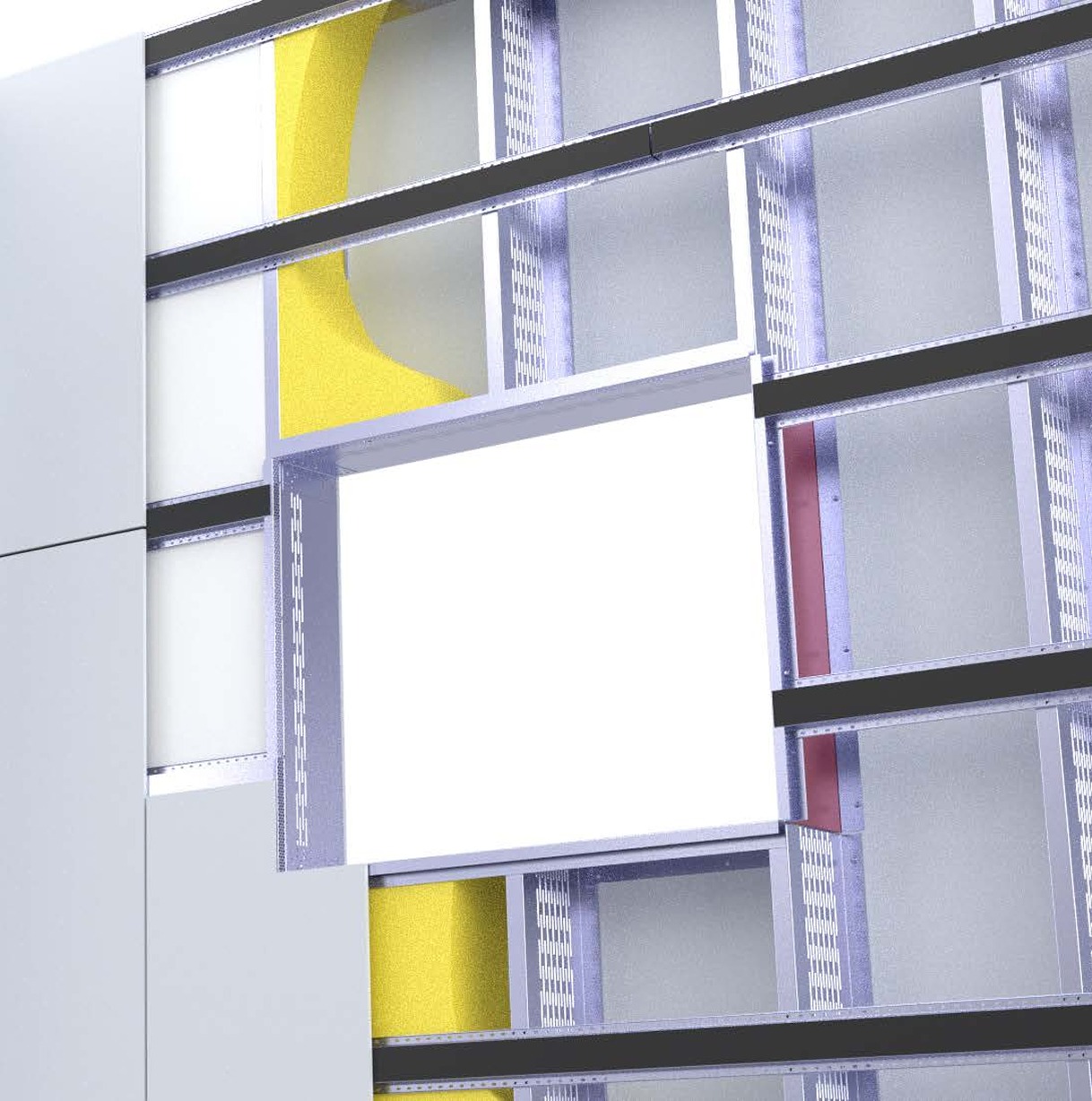
Design Recon XL
Recon Ventilated facade – for good air flow behind
Recon Ventilated facade battens are used to create vertical and horizontal air flow behind the facade material.
The aim is to comply with the Swedish National Board of Housing, Building and Planning's general recommendations: "Facade cladding made of wood paneling, boards, and similar materials, as well as shell walls and plastered stud walls, are examples of structures that should be designed with capillary break and drainage between the facade cladding and the stud frame's structural protection, so that any moisture that penetrates is led out of the building. Such structures should be designed so that any moisture that gets in dries out quickly enough, even when there's local moisture."
Properties of Recon Ventilated facade
- The roof allows for a high degree of ventilation with minimal construction height.
- Normally, both battens and support battens can be replaced with ventilated battens.
- Steel protected with Magnelis, providing C5-class corrosion protection
- Horizontal or vertical battens, depending on the frame

Design Recon Ventilated facade
Recon ST – for cladding with screen tiles
Recon ST is a facade system for cladding with screen tiles. The system is constructed from profiles and components in corrosion class C5 to withstand the high stresses to which the substrate system is exposed.
Recon ST is a two-stage solution with a standing cap profile that creates a ventilated space behind the tile ridge. When the underlying structure cannot or should not be exposed to increased moisture, a membrane is installed between the profiles to create two protective zones. A first zone where intruding moisture is stopped and drained away, and a second zone that creates a well-ventilated space between the screen tile and the rear exterior wall construction.
Europrofil's facade profiles are manufactured using Magnelis®, which is designed to withstand the harshest conditions in outdoor environments. The screws used for the system's components are made from Marutex®. This is a specially treated stainless steel in corrosion class C4 with an expected service life of more than 50 years in harsh environments.
Features of Recon ST
- Steel protected with Magnelis® provides C5-class corrosion protection
- Ventilated and moisture-proof space behind the facade material
- Withstands moisture penetration during cleaning and driving rain
- Profiles are available with pre-mounted polyethylene fabric, which provides a soft contact surface for the facade material.
- Suitable for both new construction and renovation

Design Recon ST
Recon V-flex – a flexible facade system
Europrofil has developed a flexible ventilated facade batten system for horizontally mounted battens. It is suitable as a complement to both new construction and renovation projects.
Recon V-flex allows for an insulation thickness of 80–270 mm. The system consists of our ventilated facade battens (VFL) in combination with a two-part bracket fitting. With its load-bearing function, the facade battens enable direct fastening of the facade cladding, and the entire construction can be easily adapted to variations in the substrate as the bracket fitting is adjustable.
Features of Recon V-flex
- The system is well suited for bridging variations in the depth of the frame. For example, at the transition between stairwells and recesses, or at joist edges/columns between recesses.
- Recon V-flex can handle large variations or irregularities in the underlying structure.
- The system is suitable for replacing brick and plaster facades with facade boards or other facade panels.
- Possibility of adding insulation up to 270 mm

Design Recon V-flex
Recon Original – vertical battens
The Recon Original facade system for vertical battens is designed for additional insulation up to 100 mm, facade weight up to 100 kg/m², and wind load up to 3.0 kN/m².
The system can be combined with the corresponding Recon Original for horizontal battens if the project requires different solutions for different sections of the facade.
Advantages of Recon Original
For new construction:
- The roof allows for a high degree of ventilation with minimal construction height.
- Normally, both battens and support battens can be replaced with ventilated battens.
- Steel protected with Magnelis, providing corrosion protection in C5 class
- Horizontal or vertical battens, depending on the frame
When renovating:
- The system can handle variations of up to 30 mm in the facade surface.
- The system is suitable for replacing brick and plaster facades with facade boards or other facade panels.
- External additional insulation does not take up interior space and can in most cases be installed while tenants remain in the building.

Design Recon Original – Vertical

Recon Original – horizontal battens
The Recon Original facade system for horizontal battens is designed for additional insulation up to 100 mm, facade weight up to 100 kg/m², and wind load up to 3.0 kN/m².
The system can be combined with the corresponding Recon Original for vertical battens if the project requires different solutions for different sections of the facade.
Advantages of Recon Original
For new construction:
- The roof allows for a high degree of ventilation with minimal construction height.
- Normally, both battens and support battens can be replaced with ventilated battens.
- Steel protected with Magnelis, providing corrosion protection in C5 class
- Horizontal or vertical battens, depending on the frame
When renovating:
- The system can handle variations of up to 30 mm in the facade surface.
- The system is suitable for replacing brick and plaster facades with facade boards or other facade panels.
- External additional insulation does not take up interior space and can in most cases be installed while tenants remain in the building.

Design Recon Original – Horizontal
Fire protection in ventilated facades (VFL-FB)
Europrofil VFL-FB is a ventilated facade profile with integrated fire seal. The fire seal consists of a strip of expanding graphite compound that expands significantly even at low temperatures. The graphite strip expands to approximately 25 times its own thickness and can easily cope with unevenness in the air gap or in the ventilated facade.
VFL-FB is a safe, secure, and cost-effective solution for preventing the spread of fire in the air gap behind the facade material where you want to keep the ventilated air gap open.
Advantages of VFL-FB
- Effective fire protection for ventilated facades in Nordic conditions
- Extensively fire tested for up to 45 minutes in various construction materials; tests were conducted at RISE in Sweden.
- Effectively expands and seals air gaps up to 50 mm and is forgiving of unevenness in the substrate
- All-in-one: battens, fire protection, protection against flash fires and rodents
- Tested with both plasterboard and wind barrier/insulation
- The graphite tape is age-resistant and insensitive to moisture.
- Europrofil's ventilated facade battens with built-in fire protection are a convenient and quick solution on the construction site.
A common solution is to install VFL-FB at each joist edge as a replacement for a traditional VFL. As long as the installation instructions are followed, the job is done. This saves time and money and reduces the risk of incorrect installations. Europrofil's fire-resistant facade battens must be installed with fasteners spaced no more than 600 mm apart.

Designing ventilated facades
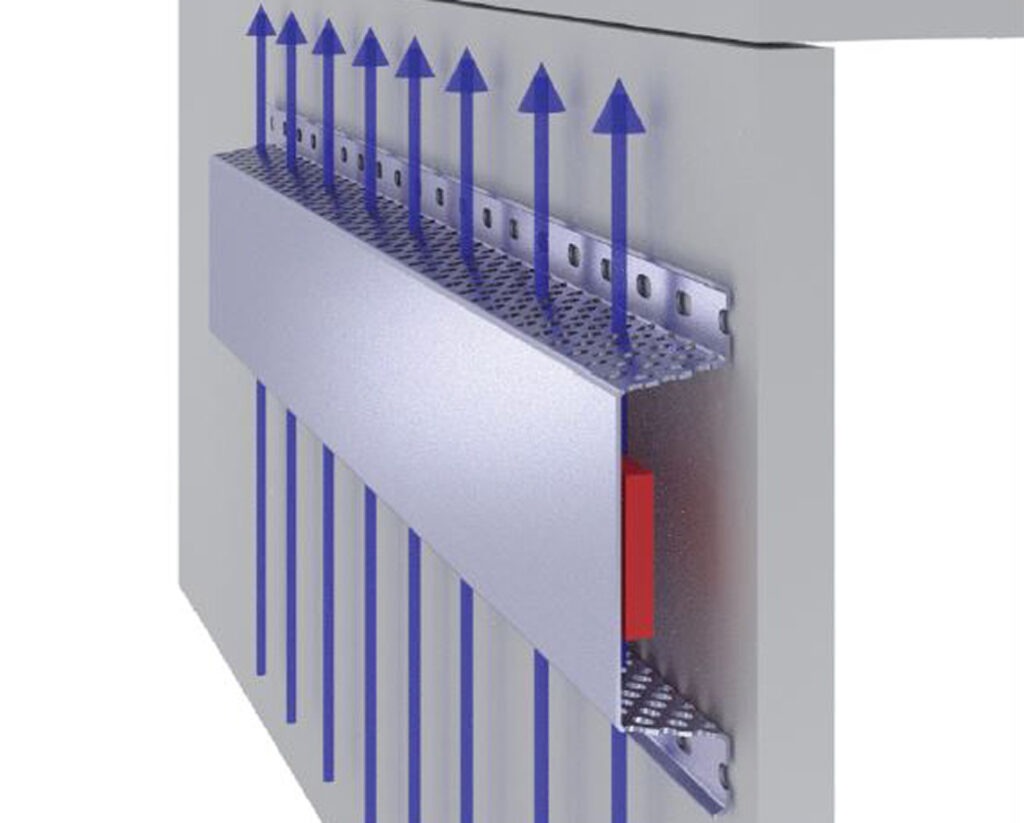
The expansion strip takes up minimal space so that ventilation through the facade profile is unobstructed.
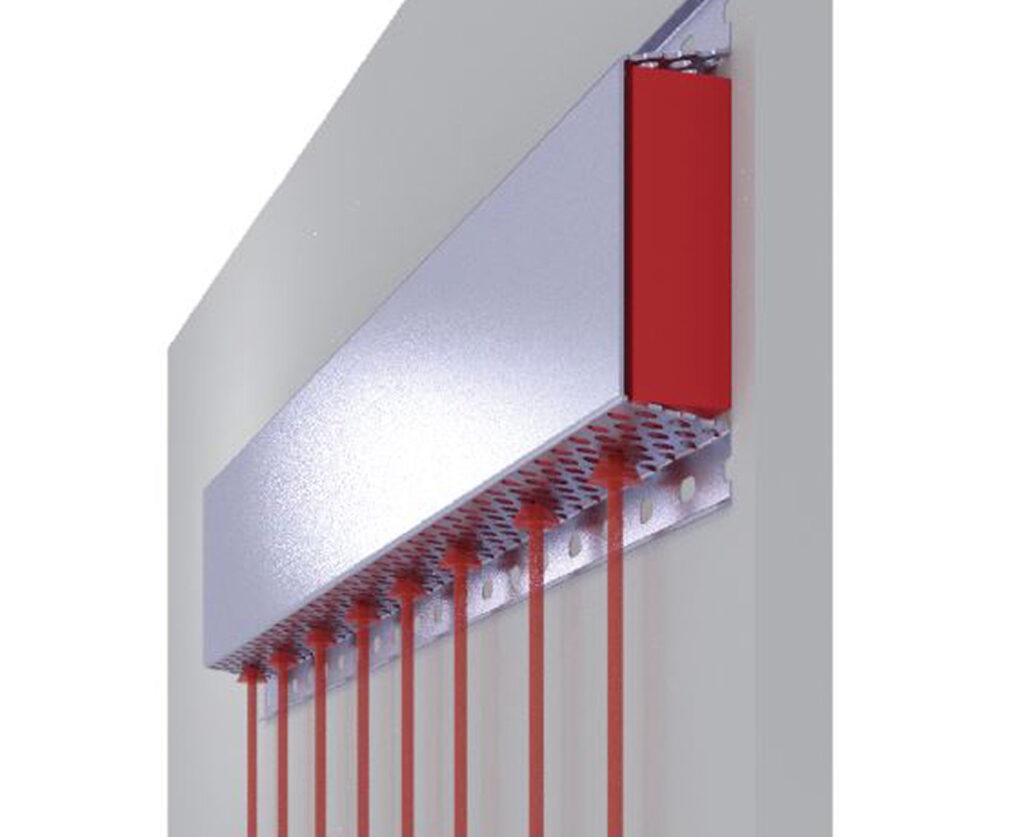
In the event of heat generation, the expansion band expands and restricts the air flow.
A solution developed in collaboration between Europrofil and FireSeal
The fire seal, or expansion strip as it is actually called, is manufactured by FireSeal, which has extensive experience of fire seals in the offshore and shipbuilding industries, among others, and guarantees a first-class, well-tested, and documented fire seal product. Test reports and approvals are available and can be ordered from Europrofil.
The fire seal consists of an intumescent tape that expands significantly even at low temperatures and is therefore forgiving of unevenness in the air gap. The graphite material is activated and expands if it starts to burn and the temperature exceeds 140°C. This means that ventilation is maintained while the air gap is fire protected. The intumescent strip expands significantly, up to 50 mm, and completely seals the air gap in the event of a fire, while the perforation in the profile prevents flames from passing through the air gap in the early stages of the fire, before the graphite in the intumescent strip has had time to expand fully.
The solution has been third-party tested at RISE test laboratories (Research Institutes of Sweden) in accordance with standard EN1364-6;201x, up to the equivalent of EI45. Tests have been carried out for use and installation in ventilated vertical air gaps in facades. The intumescent tape, Fire Barrier from FireSeal, has been assessed in several environmental assessment systems such as Svanen, Sunda Hus, Byggvarubedömningen, and Basta.